How to Make a Sound Wave Image from Any Song or Recording
A wedding song. A voicemail you've never deleted. Your kid's first laugh. Every recording has its own shape, and you can turn that shape into a design you keep.
Here's the short version:
- Open the WaveVisual editor. You don't need an account.
- Add your audio: upload a file, record it, or find a song.
- Choose a shape and colors, and add any text you like.
- Download your sound wave image.
You can try everything for free. A full-quality download needs a purchase, and our pricing page lists the options.
Add your audio
The first thing you'll do is pick a source for your audio. There are four ways to do it:
- Upload a file from your device. WAV, MP3, M4A, FLAC, OGG, and other common formats all work.
- Record something on the spot using your microphone.
- Search songs to find a track by name or artist.
- Spotify link: paste a link to any Spotify track. Our Spotify sound wave guide has the details.
Once you've added your audio, WaveVisual generates the sound wave right away.
Turn a voicemail or voice recording into a sound wave
A voice works just like a song. You only need to get the recording off your phone first:
- Voice memo: share or export it from your recording app, then upload the file.
- Voicemail on iPhone: open the message in the Phone app, tap Share, and save it to Files. Then upload it.
- Voicemail on Android: the steps depend on your phone and carrier. Look for a save or share option on the message.
- No way to export it? Play the message on speaker and capture it with the Record option in the editor. Pick a quiet room.
Voicemails can get deleted without warning, so save a copy of any message that matters as soon as you can.
Style your sound wave
The Sound Wave tab is where most of the visual work happens. The first thing to decide is the shape: Standard gives you the classic horizontal bars, while Circle arranges them in a ring. They look quite different, so try both. There are a few other styles to explore too.
Then click Edit under Wave Colors. Add up to 5 colors and they'll blend into a gradient across the waveform.
Below the colors, a few sliders fine-tune the look:
- Bar thickness: how wide each bar is.
- Space between bars: the gap between bars.
- Height (Standard only): how tall the bars are. Drag it all the way down and the wave flattens out in a way that can look surprisingly good.
- Bar length and Circle radius (Circle only): the bar size and how large the ring is.
Each slider has a reset button next to it if you want to go back to the default.
Add text
The Text tab lets you add a song title, a date, a short message, whatever fits. Start from a basic style (heading, subheading, body text), pick a font combination, or add a blank text box. You can change the font, size, and color of each one.
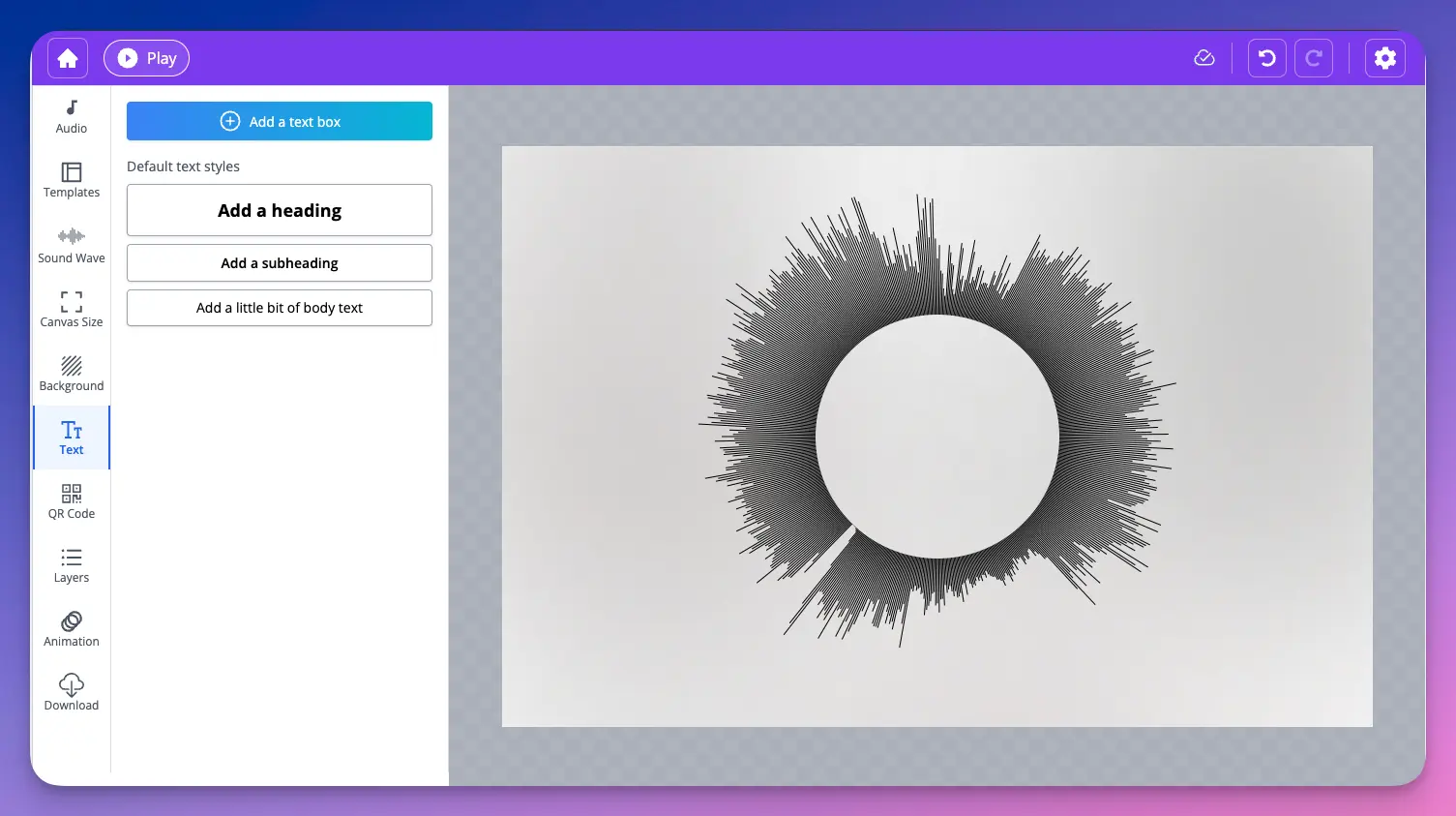
Choose a background
Under Background, set the canvas to a solid color, a gradient of up to 5 colors, or an image you upload. If you want a transparent background, there's a shortcut that clears the colors entirely.
There's also a set of built-in wallpapers: gradient images you can apply with one click.
Make it play when scanned
The sound wave itself can't be scanned, but you can add a QR code to your design. It can play your uploaded audio or open your song on Spotify. See our sound wave art with QR code page for ideas.
Download your sound wave image
When you're happy with the design, head to the Download tab and check out. Then pick a file format and download it.
Which format should you pick?
- PDF: scales to any print size without losing quality. The best choice for most print shops.
- PNG: a high-quality image that also supports transparent backgrounds. Files are larger than JPG.
- JPG: a smaller file with slight quality loss. Fine for sharing online, not ideal for printing.
- SVG: fully scalable. Useful if you want to keep editing in a tool like Illustrator or Figma.
For PNG and JPG you can also choose the resolution, from a small preview size up to a large print-ready file.
Planning to print it? WaveVisual doesn't print or ship posters at the moment, so our self-printing guide covers where to go and what to ask for.
Want it to move?
A sound wave image is a still. If you'd like a waveform that moves with your audio, upload your audio file and make a sound wave video instead. The sound wave art generator is the place to start for a still design.
Questions people ask
Can I get a sound wave from a video?
Yes, if you can save the sound as an audio file first. Then upload it like any other recording.
Do I need design experience?
No. Start from a template or change a few colors, and you'll have a finished design in minutes.
Can I make a sound wave for free?
You can design and preview it for free, with no account. A full-quality download needs a purchase.
Start with one recording
Pick the recording that matters most to you and open the editor. You'll see its shape in seconds.
More from WaveVisual: the sound wave generator, sound wave video, and pricing.